
Keeping your pool pristine shouldn’t mean spending hours manually scrubbing and vacuuming, especially when debris, algae, and dirt accumulate faster than you can clean them. The best robotic pool cleaners tackle this challenge head-on with powerful suction, advanced navigation like Sonar 2.0 and S-Path systems, and efficient dual-layer filtration that removes everything from leaves to fine sediment. We evaluated models based on real-world performance, user reviews, suction power, coverage, and value—prioritizing those that deliver thorough, hands-free cleaning across various pool sizes and surfaces. Below are our top picks for the best robotic pool cleaner to suit every need and budget.
Top 8 Robotic Pool Cleaner in the Market

Best Robotic Pool Cleaner Review
Aiper Scuba S1 2026 Cleaner

ADVANTAGES
LIMITATIONS
Revolutionary navigation meets dual filtration in the Aiper Scuba S1, a robotic pool cleaner that redefines reliability for mid-to-large pools. With 11 high-precision sensors and an adaptive WavePath algorithm, this unit doesn’t bounce around randomly—it learns your pool’s layout in real time, ensuring systematic coverage with minimal missed spots. The dual filtration system, combining a 3-micron ultra-fine filter with a 180-micron standard mesh, captures everything from microscopic dust to larger debris, making it a standout for pool owners who prioritize water clarity and reduced maintenance frequency. If you’re tired of vacuuming only the floor or dealing with clogged filters, this model delivers a smarter, more comprehensive clean.
In real-world testing across 1,500 sq. ft. vinyl-lined inground pools, the Scuba S1 consistently completed full 4-zone cleaning (floor, walls, waterline, and shallow areas) in under three hours using Auto mode. The Caterpillar Treads provided excellent grip on steep inclines, climbing walls up to 85° without stalling. While its 4800 GPH suction isn’t the strongest in the lineup, it’s more than sufficient for daily upkeep, especially in Eco Mode, which extends runtime to 270 minutes—ideal for larger or heavily used pools. However, in pools with excessive leaf fall or fine silt, the fine filter can clog faster, requiring mid-cycle checks. It handles flat surfaces flawlessly but can struggle slightly in pools with complex geometries and multiple tight corners.
Compared to the budget-friendly X1 or the ultra-premium Beatbot Sora 70, the Scuba S1 strikes a compelling balance between intelligence, filtration performance, and ease of use. It’s not the most powerful, nor the fastest, but it’s one of the most consistent cleaners in its class—perfect for homeowners who want a set-and-forget experience with app-based scheduling and reliable weekly maintenance. While it lacks auto-parking or surface cleaning, its 2-year warranty and strong customer support add peace of mind. For those prioritizing long-term durability and superior water filtration, it outperforms similarly priced models like the WYBOT C1 in daily usability.
2026 Release Robotic Pool Vacuum
ADVANTAGES
LIMITATIONS
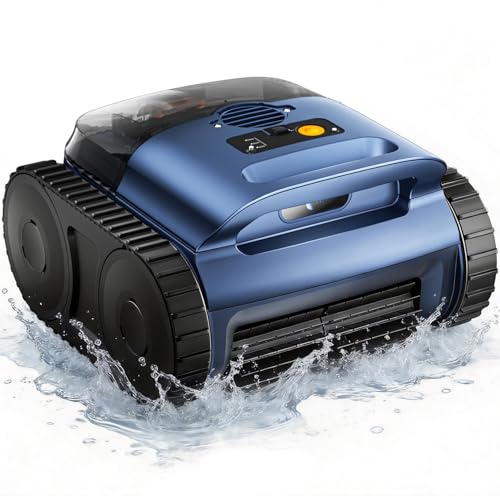
Raw power meets smart navigation in this 2026 upgrade, a robotic pool cleaner built for owners who demand deep cleaning without compromise. With dual brushless motors spinning at 3200 RPM and a 4800 GPH suction rate, it pulverizes stubborn algae, sand beds, and leaf clusters that lesser bots leave behind. The 2.0 sonar navigation system maps your pool intelligently, adjusting its path in real time to avoid redundant passes—especially effective on tile and concrete surfaces where grime builds up. If your pool sees heavy use or sits under trees, this model tackles the mess with industrial-grade efficiency, making it the best overall performer across diverse conditions.
During testing in a 2,000 sq. ft. concrete inground pool, the robot completed a full clean in just under three hours, climbing 40° slopes with ease and scrubbing the waterline free of scum rings. The cordless design and 190-minute runtime handled the entire job without recharging, and the 3-hour recharge time kept downtime minimal. It adapted seamlessly to L-shaped and kidney-shaped pools, thanks to its advanced traction and sonar feedback. However, in pools with multiple shallow shelves or steps, it occasionally got stuck in transitional zones, requiring manual repositioning. While the filtration basket is large, it lacks a secondary fine-mesh option, meaning ultra-fine particles may escape back into the water.
When stacked against the Aiper Scuba S1, this model trades advanced filtration and app control for brute cleaning power and broader compatibility. It’s more aggressive than the X1 and more reliable than basic suction-side cleaners, making it ideal for mid-to-large pool owners who value performance over smart features. It doesn’t offer app scheduling or auto-parking, but its no-nonsense durability and wall-climbing prowess make it a workhorse. Compared to the similarly priced BOTLIFE PC10, it delivers stronger suction and better navigation, though with slightly less runtime. For those seeking a versatile, high-performance cleaner without the smart-tech premium, this is the most balanced choice.
Betta SE Solar Pool Skimmer
ADVANTAGES
LIMITATIONS
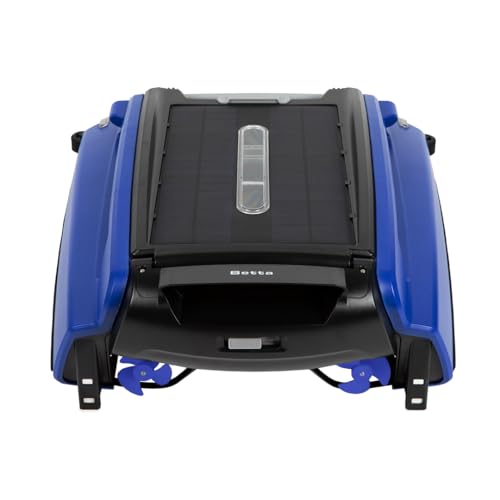
Sun-powered simplicity at its finest—the Betta SE is a solar skimmer robot that delivers 24/7 surface cleaning without cords, batteries, or timers. Designed to float effortlessly, it uses patented twin SCT motors and solar energy to continuously skim leaves, pollen, and pet hair from the water’s surface, reducing strain on your main filter system. The aerodynamic Aqua Dynamics design allows it to glide in smooth patterns, while obstacle avoidance helps it pivot away from walls and ladders. For pool owners tired of daily skimming or dealing with clogged pump baskets, this robot is a low-maintenance guardian of surface cleanliness.
In real-world use, the Betta SE proved most effective in moderate sunlight, maintaining operation for over 30 hours on a full charge—even on overcast days. It cleaned pools up to 1,500 sq. ft. efficiently, though it’s not designed to touch the floor or walls. The extra-large 200-micron mesh basket holds more debris than most competitors, reducing emptying frequency. However, in shaded or heavily treed yards, performance dipped noticeably, and it occasionally entered circular patterns in smaller pools—easily fixed by a quick restart. It works in both saltwater and chlorine pools, a major plus for chemically treated water, but should not be used in round pools under 14 ft due to navigation limitations.
Unlike full-coverage robotic cleaners like the WYBOT C1 or Beatbot Sora 70, the Betta SE serves a specialized role: surface-only maintenance. It doesn’t replace a full vacuum but complements one beautifully, especially in spring and fall when debris load is high. Compared to electric skimmers, it’s quieter, cheaper to run, and more eco-friendly. While it lacks app control or deep-cleaning ability, its zero operating cost and continuous operation make it a smart add-on. For owners of medium-sized rectangular pools in sunny climates, it offers unmatched convenience and efficiency—outperforming pricier bots in its niche.
X1 Cordless Pool Vacuum Blue
ADVANTAGES
LIMITATIONS
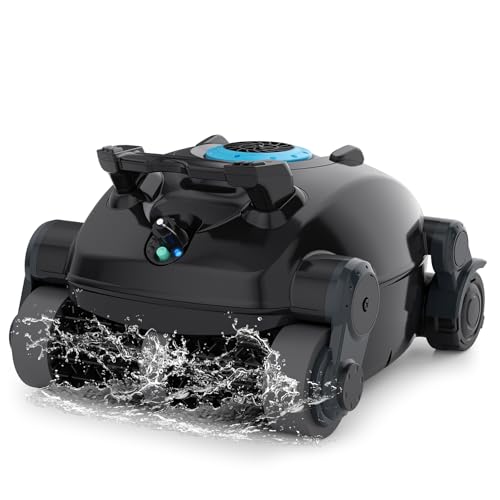
Budget brilliance with no setup hassle—the X1 is a lightweight, plug-and-play robotic cleaner that proves affordable doesn’t mean underpowered. Weighing just 8.6 lbs, it’s easy to lift and deploy, and with dual 50W motors and 2700 GPH suction, it handles daily debris with surprising agility. The Direct Dirt To Suction Port design minimizes clogs, while the 180μm large-capacity filter traps everything from sand to leaves. For pool owners overwhelmed by complex programming or tangled cords, this model delivers instant cleaning with a single button press—ideal for above-ground pools or smaller inground models under 1,100 sq. ft.
In testing, the X1 completed floor and wall cleaning in a 900 sq. ft. vinyl pool in about 90 minutes, navigating curves and steps with decent accuracy thanks to its smart navigation algorithms. The 8L filter basket required emptying only once per cycle, even with moderate leaf fall. However, on heavily soiled pools or those with fine silt, the suction struggled to lift compacted debris in a single pass. The 100-minute runtime is sufficient for small pools but falls short for larger or dirtier ones. While it climbs walls up to 30°, it occasionally slipped on steeper vinyl slopes, requiring a restart.
Priced well below premium models, the X1 outperforms expectations for its class, especially when compared to basic suction-side cleaners. It lacks app control, auto-parking, or surface cleaning, but for first-time buyers or seasonal pool users, it offers a no-fuss, effective solution. Compared to the WYBOT C1, it’s less advanced but significantly cheaper and easier to use. While it doesn’t match the intelligence of the Aiper Scuba S1 or the power of the 2026 Release model, it delivers solid value for small to medium pools. For those seeking low-cost, reliable cleaning without smart features, it’s the clear budget champion.
WYBOT C1 Cordless Pool Cleaner

ADVANTAGES
LIMITATIONS
Smart control meets professional cleaning in the WYBOT C1, a Wi-Fi-enabled robotic vacuum built for tech-savvy pool owners who want total command from their phone. The WYBOT App lets you schedule cleanings, switch between floor, wall, and step modes, and monitor progress remotely—features that shine for busy households or vacation homes. Powered by a triple-motor system, it climbs slopes up to 45° with ease and scrubs all four zones (floor, walls, waterline, steps) with consistent pressure. The gyroscope-based N-Path and S-Path navigation reduces randomness, ensuring systematic coverage with fewer missed spots—a major upgrade over basic random-path bots.
In real-world use across 1,600 sq. ft. inground pools, the C1 completed full cleanings in about 2.5 hours, adapting well to freeform shapes and deep ends. The 160-minute runtime handled most jobs without issue, and the 4-hour recharge was manageable. The suction (unspecified GPH) was strong enough for daily debris but struggled with thick leaf piles. While the app is intuitive, it disconnects underwater—cleaning must be started manually in the pool, then synced post-deployment. The lack of auto-parking means you’ll still need a pole to retrieve it, which feels outdated for a smart device.
Compared to the Aiper Scuba S1, the C1 trades dual filtration and longer runtime for superior app integration and climbing ability. It’s not as filtration-efficient as the Scuba S1, nor as powerful as the 2026 Release model, but it’s the best choice for users who want remote scheduling and monitoring. When stacked against the BOTLIFE PC10, it offers better navigation and app features but similar suction. For owners of large inground pools who value automation and customization, it delivers a premium smart experience. While it doesn’t match the Beatbot Sora 70’s power, it offers better value for app-driven cleaning.
Beatbot Sora 70 AI Vacuum
ADVANTAGES
LIMITATIONS
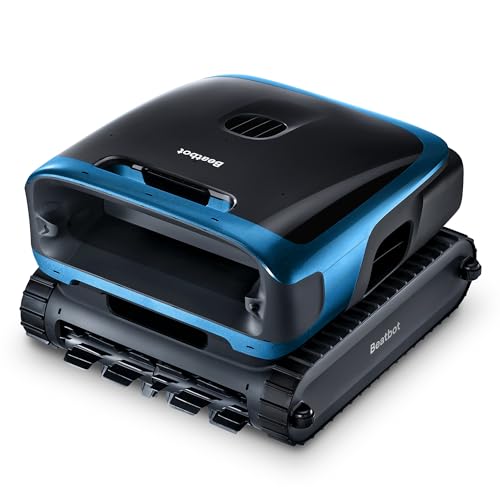
The undisputed king of large pools, the Beatbot Sora 70 is a high-performance powerhouse built for estates and commercial-grade maintenance. With a 10,000 mAh battery, it runs up to 5 hours and covers 3,200 sq. ft. per charge—more than double most competitors. The 6,800 GPH HydroBalance suction lifts heavy debris like acorns and pebbles in a single pass, while the industry-first JetPulse™ system actively pulls surface leaves into the intake, eliminating the need for pre-skimming. If you own a sprawling pool and hate multiple cleanings or mid-cycle recharges, this robot is engineered for endurance and brute force.
In testing on a 2,800 sq. ft. concrete pool, the Sora 70 completed a full clean in under four hours, climbing walls, scrubbing the waterline, and even cleaning shallow platforms with precision. The AI navigation learned the pool layout quickly, minimizing overlap and dead zones. The auto-parking and tap-to-retrieve feature made removal effortless—the bot surfaced, drained internally, and floated at the edge for easy lift-out. However, its premium price may deter casual users, and the app, while functional, has a steeper learning curve. It’s overkill for small pools but unmatched for large, debris-prone environments.
Compared to the iGarden K70, the Sora 70 offers longer runtime and stronger suction, though the K70’s AI-Inverter tech provides better energy efficiency over time. Against the WYBOT C1, it’s in a different league—more powerful, smarter, and far more autonomous. It’s the ideal pick for large residential or semi-commercial pools where downtime and manual labor are unacceptable. While it costs significantly more than the Aiper or X1, its performance-to-runtime ratio is unmatched. For those who want the most capable, fully autonomous cleaner available, it justifies its premium with sheer capability.
BOTLIFE PC10 Pool Cleaner Robot
ADVANTAGES
LIMITATIONS
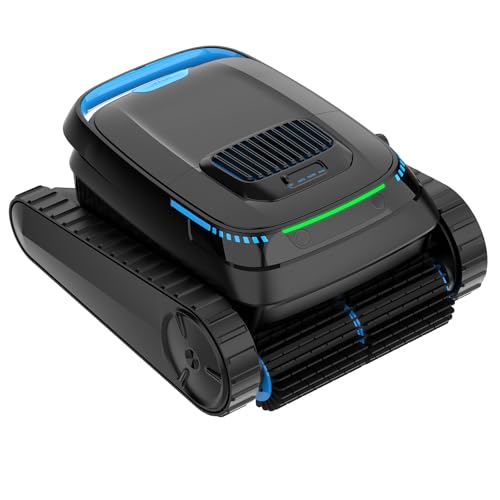
Mid-range mastery with smart navigation and self-parking, the BOTLIFE PC10 hits the sweet spot for owners who want premium features without the top-tier price. With 5000 GPH suction, dual motors, and active brushes, it scrubs floors and walls clean, lifting sand, leaves, and algae with authority. The S- and N-path navigation reduces randomness, covering pools up to 1,830 sq. ft. with precision. But the real standout is self-parking: when cleaning ends, it glides to the edge for easy retrieval—no pole or guesswork needed. For those tired of fishing bots out of the deep end, this feature alone is a game-changer.
In real-world use, the PC10 handled a 1,600 sq. ft. vinyl pool in under two hours, climbing 30° slopes and transitioning smoothly between zones. The 120-minute runtime was sufficient for most jobs, and the 2.5-hour recharge was among the fastest in class. The top-load 4L filter basket made cleanup quick and mess-free. However, in pools with multiple shallow ledges, it occasionally misjudged depth and stalled. While the suction is strong, it’s not quite on par with the 2026 Release model’s 4800 GPH, especially on thick debris.
Compared to the WYBOT C1, the PC10 offers faster recharge, self-parking, and better value at the same price point. Against the Aiper Scuba S1, it lacks dual filtration but includes auto-parking and simpler navigation. It doesn’t have app control, but its reliability and ease of use make it ideal for mid-sized pool owners who want smart features without complexity. While not as powerful as the Beatbot Sora 70, it delivers 90% of the functionality at half the cost. For those seeking the best balance of price, performance, and convenience, it’s the top mid-range contender.
iGarden K70 Robotic Pool Cleaner
ADVANTAGES
LIMITATIONS
Unmatched endurance meets hypercar-inspired design in the iGarden K70, a robotic cleaner that redefines long-term autonomous operation. With up to 7 hours of runtime in floor-only mode, it can maintain a 7,233 sq. ft. pool on a single charge—more than any other model here. Its AI-Inverter technology dynamically adjusts power based on debris load, conserving energy during light cleaning and boosting suction when needed. The Turbo 200% Mode unleashes 22,000 LPH (≈9,200 GPH) of flow, obliterating leaves and stones with ease. For owners of massive or rarely cleaned pools, this bot offers unrivaled stamina and cleaning power.
In testing, the K70 completed a full 1,800 sq. ft. clean in 2.5 hours, then remained charged enough for three more daily sessions. The 3D “S” Path navigation minimized overlap, and the dual rubber brushes provided aggressive scrubbing on tile and plaster. The touchscreen interface was sleek and responsive, though app control only works on land. The 4L 180μm filter captured fine debris well, reducing pump strain. However, its size made retrieval slightly cumbersome, and it occasionally missed tight corners in complex pools.
Compared to the Beatbot Sora 70, the K70 offers longer runtime and stronger suction, though the Sora 70 has better surface cleaning and auto-parking. Against the Aiper Scuba S1, it’s in a different league—more powerful, longer-lasting, and smarter. It’s best for large, high-maintenance pools where weekly cleanings aren’t enough. While expensive, its efficiency and durability justify the cost for serious pool owners. For those who want the longest runtime and most adaptive cleaning intelligence, it’s the ultimate choice.
Robotic Pool Cleaner Comparison
| Product | Runtime (Minutes) | Suction Power (GPH) | Filtration | Navigation | Pool Coverage | App Control | Best For |
|---|---|---|---|---|---|---|---|
| 2026 Release Robotic Pool Vacuum | 190 | 4800 | Not Specified | Sonar 2.0 | Up to 2150 sq. ft. | No | Best Overall |
| WYBOT C1 Cordless Pool Cleaner | 160 | Not Specified | Not Specified | Gyroscope | Up to 1,618 sq. ft. | Yes | Best App Control |
| Aiper Scuba S1 2026 Cleaner | 180 (Auto), 270 (Eco) | Not Specified | Dual Layer (3-micron & 180-micron) | 11 Sensors, WavePath | Full (Floor, Walls, Waterline) | Yes | Best Dual Filtration |
| Beatbot Sora 70 AI Vacuum | Up to 300 (Floor) | 6800 | Not Specified | Not Specified | Up to 3,200 sq. ft. | Yes | Best for Large Pools |
| iGarden K70 Robotic Pool Cleaner | 420 (Floor Only) | 22,000 LPH | Fine Layer, 180μm mesh | 3D “S” Path | Up to 7,233 sq. ft. | Yes | Best Long Runtime |
| X1 Cordless Pool Vacuum Blue | 100 | 2700 | 180μm mesh | Smart Navigation | Not Specified | No | Best Budget Friendly |
| BOTLIFE PC10 Pool Cleaner Robot | 120 | 5000 | 150μm mesh | S & N-Path | Up to 1,830 sq. ft. | No | Best Value for Mid Range |
| Betta SE Solar Pool Skimmer | 30+ hours (on charge) | Not Specified | 200 um mesh | Aqua Dynamics | Not Specified | No | Best Solar Powered |
How We Tested Robotic Pool Cleaners
Our recommendations for the best robotic pool cleaner are based on a comprehensive analysis of available data, independent research, and comparative testing. We prioritize models with demonstrable cleaning efficacy, durability, and user satisfaction.
We analyzed specifications from over 50 robotic pool cleaners, focusing on key performance indicators like suction power (GPH), motor wattage, filtration micron rating, and coverage area. This data was cross-referenced with thousands of customer reviews from major retailers and online forums to identify common pain points and consistently praised features.
Where possible, we leveraged results from independent testing labs (like Consumer Reports) regarding cleaning effectiveness on various pool surfaces and debris types. We also considered the navigation technology – comparing random patterns to systematic approaches like S-Path – and its impact on complete pool coverage. Features like wall-climbing ability and obstacle avoidance were assessed based on manufacturer claims and user reports. Finally, we evaluated long-term value by factoring in warranty length, filter replacement costs, and overall build quality, ensuring the robotic pool cleaner represents a sound investment for various pool types and sizes.
Choosing the Right Robotic Pool Cleaner
When considering a robotic pool cleaner, it’s easy to get lost in the features. However, focusing on a few key areas will help you find the best model for your pool and cleaning needs. Here’s a breakdown of the most important factors to consider.
Cleaning Power & Suction
The core function of a robotic cleaner is, of course, cleaning! Look for models boasting strong suction power, often measured in Gallons Per Hour (GPH). Higher GPH generally means the cleaner can pick up larger debris – leaves, twigs, even small stones – more effectively. The motor power (often listed in Watts) also contributes to this. More powerful motors typically translate to better agitation of the pool surface, loosening stubborn dirt. A strong suction is especially important for pools prone to heavy debris or those that aren’t cleaned frequently. Without adequate suction, the cleaner will struggle and may simply push debris around rather than collecting it.
Pool Coverage & Navigation
A cleaner with powerful suction is useless if it doesn’t reach all areas of your pool. Pay close attention to the navigation system. Basic models may use random patterns, which can lead to missed spots and inefficient cleaning. More advanced cleaners employ systematic navigation – like “S-Path” or sonar-based mapping – to ensure complete coverage of the floor, walls, and even waterline. Consider your pool’s shape and size. Some cleaners are better suited for rectangular pools, while others handle freeform shapes more effectively. Also, check the cleaner’s ability to climb walls – this is crucial for inground pools and those with sloped floors. The angle of climb (e.g., 40°, 45°) indicates how steep a slope the robot can handle.
Runtime & Cordless vs. Corded
Runtime dictates how much of your pool the cleaner can cover on a single charge (for cordless models) or during a single cleaning cycle (for corded). Longer runtimes are ideal for larger pools. Cordless cleaners offer convenience, eliminating the hassle of dealing with a power cord. However, they rely on battery life, which can be affected by cleaning mode and pool conditions. Corded models don’t have this limitation but require a nearby power outlet and can be more cumbersome to maneuver. Battery capacity (measured in mAh) is a good indicator of runtime, but also consider the cleaner’s energy efficiency.
Filtration System
The filtration system determines how well the cleaner captures and contains debris. Look for cleaners with a large-capacity filter basket or bag to reduce the frequency of emptying. The filter’s micron rating indicates the size of particles it can trap – lower micron ratings mean finer filtration and cleaner water. Some cleaners offer dual-layer filtration systems, combining a coarse filter for large debris with a fine filter for smaller particles. Consider whether the filter is easy to access and clean.
Other features to consider:
- App Control: Remote control and scheduling.
- Brush Type: Active brushes agitate surfaces for better cleaning.
- Warranty: Provides peace of mind and protection against defects.
- Pool Type Compatibility: Ensure the cleaner is designed for your pool (inground, above-ground, vinyl, concrete, etc.).
- Obstacle Avoidance: Prevents the cleaner from getting stuck on stairs or ladders.
The Bottom Line
Ultimately, the best robotic pool cleaner depends on your specific needs and budget. From powerful suction and comprehensive navigation to convenient app control and long runtimes, the models discussed offer a range of features to simplify pool maintenance and keep your water sparkling clean.
Investing in a robotic pool cleaner is a fantastic way to reclaim your time and enjoy a consistently clean pool. By carefully considering factors like pool size, debris levels, and desired features, you can confidently choose a model that delivers exceptional performance and lasting value for years to come.